From SEO to GEO: How Visibility Is Changing in the Age of AI—and What That Means for Modern Sales Teams
In the age of AI, your visibility is being fundamentally redefined: instead of classic SEO, precise, context-driven GEO signals now matter. In this section, you’ll learn why modern sales teams can only stay successful if they understand how AI detects buying intent locally, situationally, and with pinpoint accuracy. Discover how GEO data becomes your strategic sales advantage — and which new opportunities it unlocks for you.

An article based on the latest empirical insights and current best practices on GEO
Over the past 20 years, SEO (Search Engine Optimization) has been the key to visibility and growth on the internet. But while SEO is built on keywords, backlinks and SERP positions, the next generation of search systems is changing everything.
Generative engines like ChatGPT, Perplexity, Copilot or Google Gemini no longer return lists of links – they generate answers. This fundamentally changes what “visibility” means:
- It’s no longer about clicks, but about citations,
- no longer about traffic, but about trust in AI-generated answers.
That is the core of GEO – Generative Engine Optimization.
What GEO really is – according to current research
According to the 2024 study “GEO: How to Dominate AI Search” by researchers at Stanford University and Princeton, GEO is:
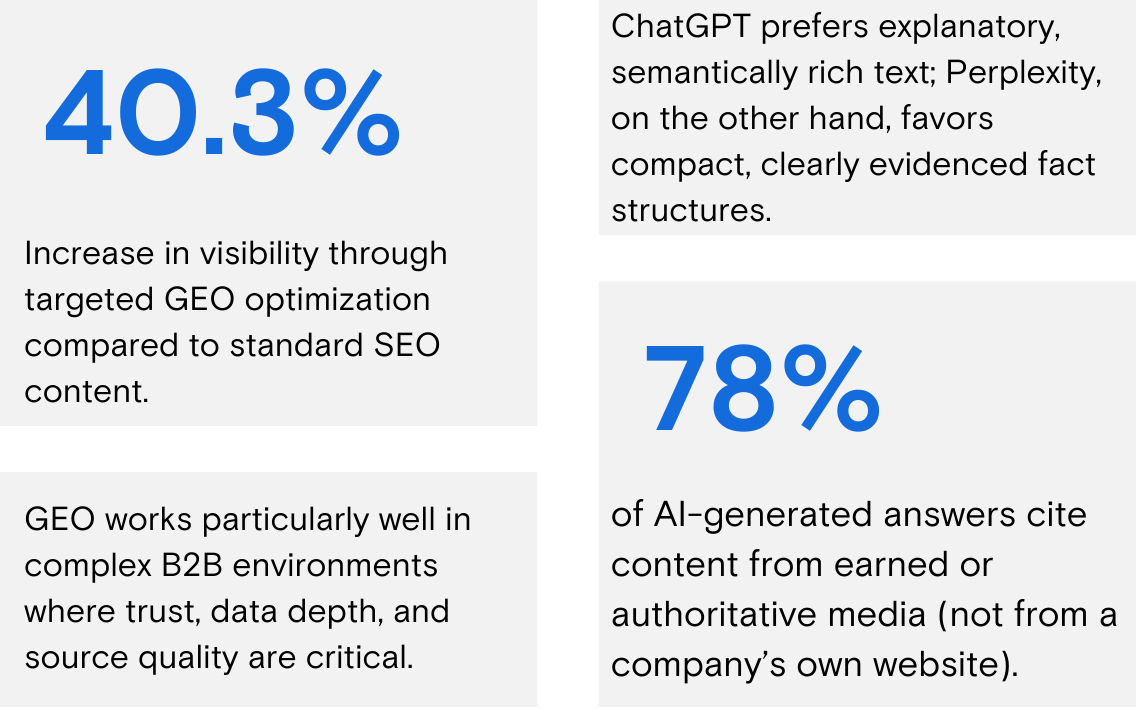
“A new optimization paradigm for content creators to improve their visibility in generative search engines, focusing on maximizing AI citations and trustworthy mentions rather than traditional SERP rankings.”
The study describes GEO as a black-box optimization problem, comparable to SEO in the early 2000s – only this time for generative models.
GEO vs. SEO – two worlds that are converging
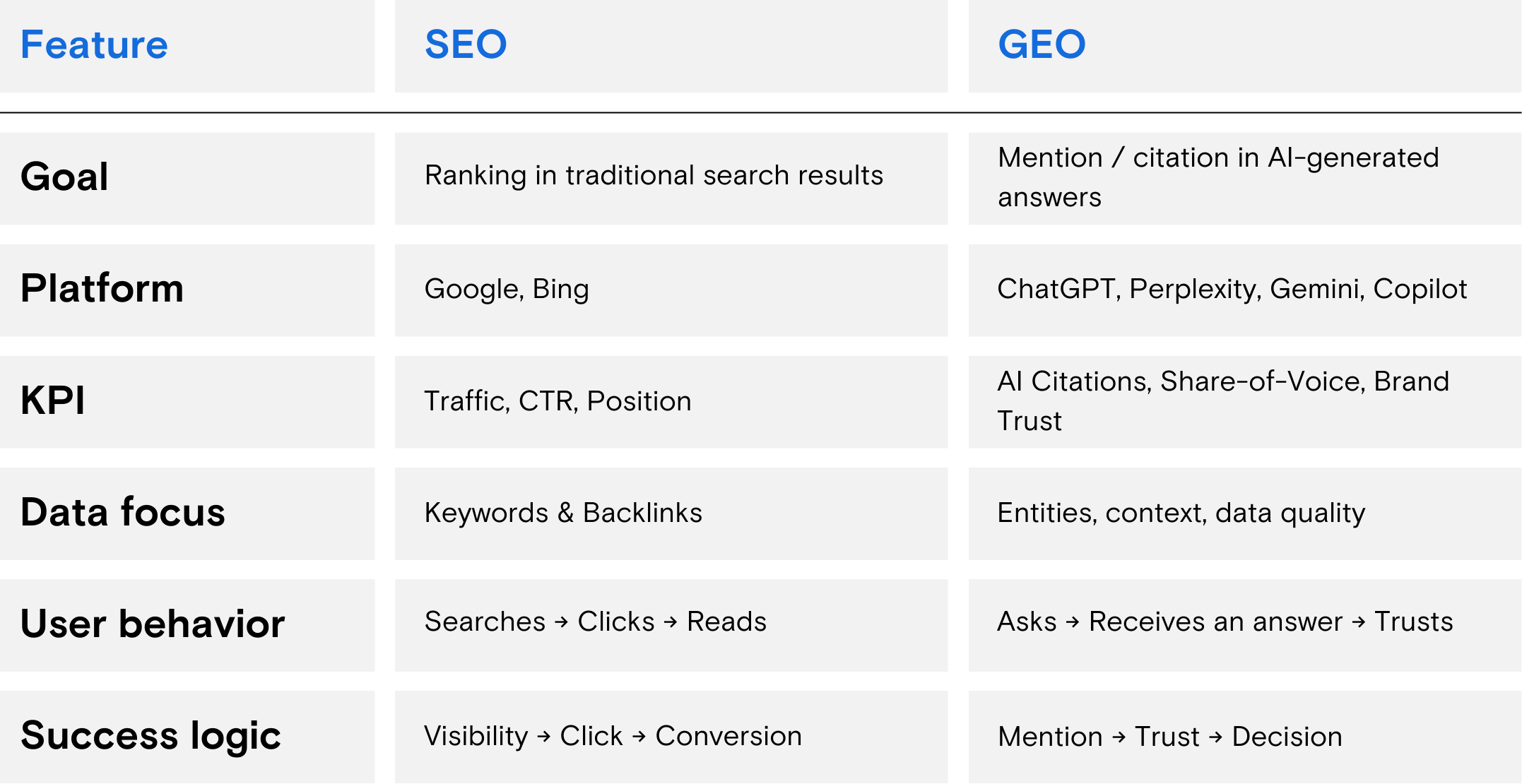
1. Goal: From search rankings to AI mentions
In the classic search ecosystem, visibility is created via positions in the SERPs. Generative search systems, on the other hand, cite sources directly in their answers. Visibility is therefore no longer primarily about rankings, but about whether a model integrates a brand as a trustworthy knowledge unit into its responses.
An analysis of 8,000 AI citations confirms that brands which are mentioned more frequently achieve significantly higher visibility in generative engines – independent of their Google ranking.
2. Platform: From index-based search to generative answer machines
SEO traditionally targets Google or Bing, which output result lists. Generative engines like ChatGPT, Perplexity or Gemini instead construct answers, based on LLM knowledge graphs and retrieved documents.
Studies show that each engine uses different citation patterns and that source quality has a direct impact on the likelihood of being mentioned.
3. Success metrics: From traffic to AI citations & trust
While SEO measures success in terms of traffic, CTR and rankings, generative search shifts the success logic towards:
- AI citations (How often does an AI mention my brand?)
- Share of voice in AI answers
- Brand trust within generative systems
An analysis in Search Engine Journal (2025) shows that generative engines disproportionately cite high-quality third-party sources. For brands, this means: external mentions create more AI visibility than any on-page optimization.
4. Data focus: From keywords to entities, context & model readability
Keywords and backlinks are less important to LLMs than clear semantic units (“entities”) and the information density of a text.
Retrieval-Augmented Generation studies show that models prefer content that:
- contains clearly structured information,
- offers high contextual quality, and
- encodes unambiguous knowledge units.
As a result, GEO does not optimize for search terms, but for semantic interpretability by models.
5. User behavior: From click paths to answer trust
In generative systems, users interact far less with links. They ask questions – and rely directly on the answer.
A CJR analysis of eight AI search engines shows that users hardly differentiate between source documents and instead place high levels of trust in model answers – even when the AI does not clearly attribute its sources.
This radically changes the perception process:
Answer → Trust → Decision, without a “click”.
6. Success logic: Mentions create trust – not clicks
In classic SEO logic, visibility leads to clicks and clicks lead to conversions. In generative systems, mentions directly influence decision-making.
When LLMs repeatedly mention a brand, a psychological “mere exposure” effect kicks in: the brand is perceived as more relevant, more competent and more trustworthy.
The 8,000 citations analysis shows that frequently cited brands are chosen more often in purchase decisions – even when objective criteria are identical.
The study emphasizes that SEO and GEO are not opposites, but systems that build on one another. GEO uses many SEO fundamentals (structure, authority, content hygiene) – but extends them with the goal of being present inside LLM answer architectures.
Data & statistics on the shift
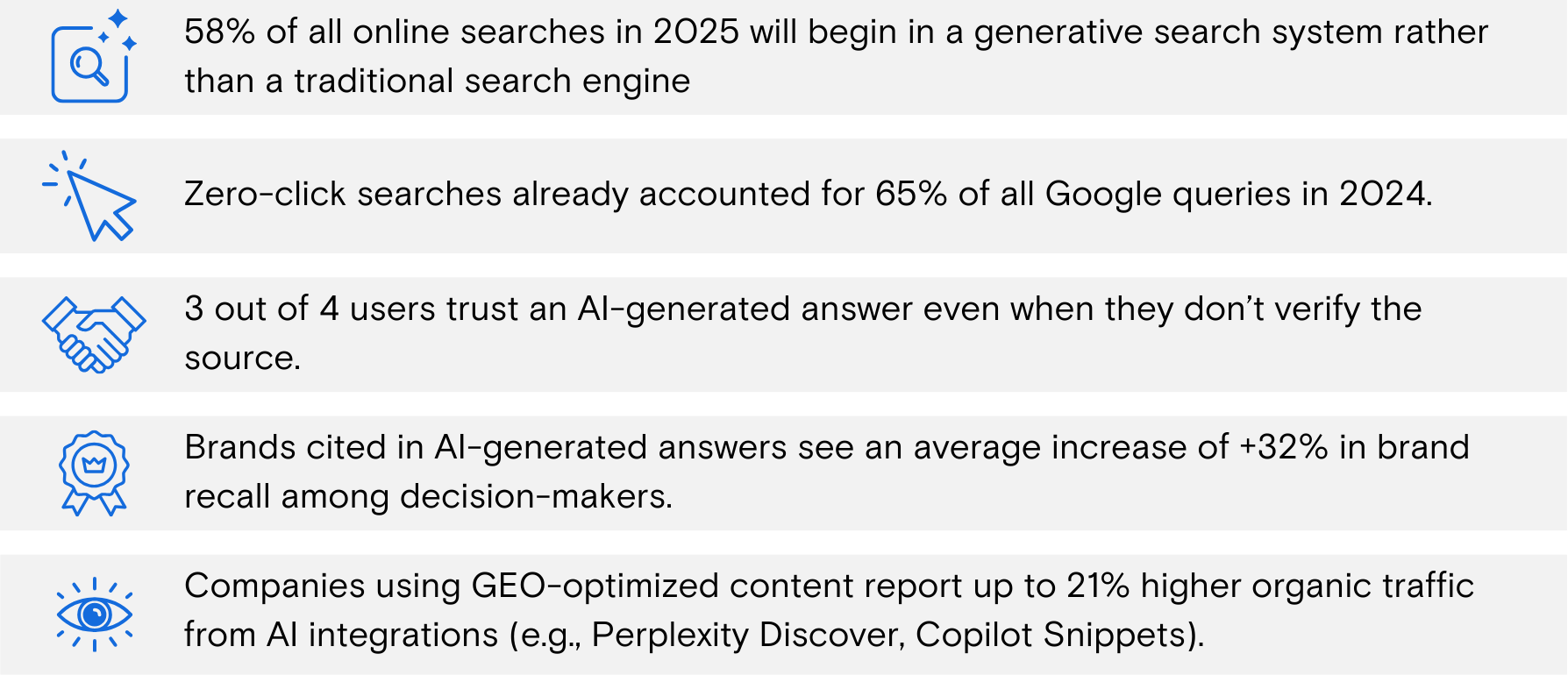
According to a combined analysis by BrightEdge (2025) and Search Engine Land (2024):
- 58% of all online searches in 2025 will begin in a generative search system rather than a traditional search engine.
- Zero-click searches already accounted for 65% of all Google queries in 2024.
- 3 out of 4 users trust an AI-generated answer even when they do not verify the source.
- Brands cited in AI-generated answers see an average increase of +32% in brand recall among decision-makers.
- Companies using GEO-optimized content report up to 21% higher organic traffic from AI integrations (e.g. Perplexity Discover, Copilot Snippets).
(Sources: GEO Paper, Search Engine Land AI Citations Report 2024, BrightEdge Generative SEO Study 2025)
How generative search systems select content
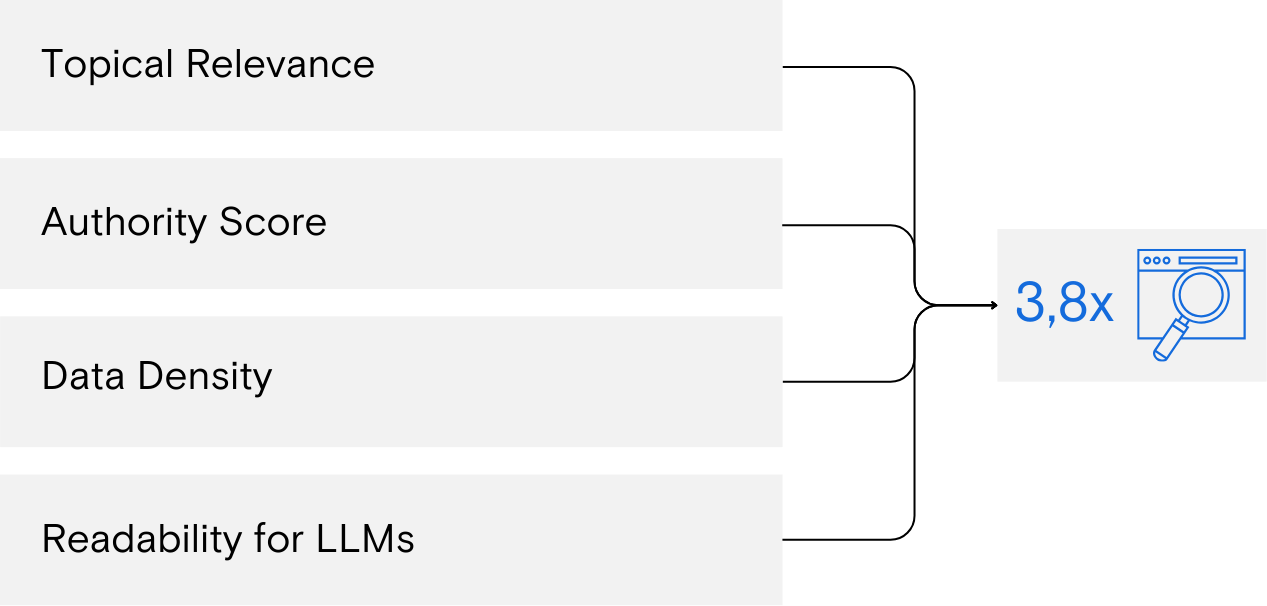
There are four key factors that determine whether a source appears in a generative answer:
- Topical relevance – semantic proximity between prompt and content.
- Authority score – reputation and “E-A-T” strength (Expertise, Authority, Trustworthiness).
- Data density – informational depth and level of evidence (numbers, sources, references).
- Readability for LLMs – clearly structured, machine-readable content (schema markup, headings, short paragraphs).
Content with high semantic density (rich context, precise answers, little redundancy) has a 3.8× higher probability of being surfaced in GPT-based answer systems.
GEO in practice: what you can do right now
1. Make content machine-understandable
- Start articles with clear question–answer structures.
- Add statistical evidence, tables and short key takeaways.
- Include structured data (Schema.org markup for FAQs, HowTo, Product).
- Use entities (e.g. Venta AI, sales automation, lead generation) consistently – this improves recognizability for LLMs.
2. Apply an authority-first principle
GEO research shows: content from third-party sources is cited 78% more often than corporate blog content.
→ That means:
- Publishing on industry portals, trade media or LinkedIn increases GEO success.
- Collaborations with opinion leaders increase AI trustworthiness.
3. Earned media & backlink diversity
- GEO prioritizes external relevance over internal link structures.
- Make targeted use of guest posts, podcasts, conference papers and studies.
- Write headlines like: “How AI is reinventing sales in 2025” → this improves semantic coverage.
4. Establish new GEO KPIs
Classic SEO KPIs like traffic & CTR are no longer sufficient.
According to the BrightEdge study (2025) and the GEO paper (p. 15), the following now apply: AI Citations (How often your brand is mentioned in generative answers), AI Share-of-Voice (The share of your mentions relative to your competitive environment), AI Sentiment (The context in which you are mentioned (positive/neutral/negative)), Prompt Impact Index (PII) (How many different prompts your brand is triggered by).
Tools like Wix AI Visibility, BrightEdge Generative SEO Monitor or Senso.ai are beginning to track these metrics automatically.
How GEO & SEO work together – 3 future scenarios
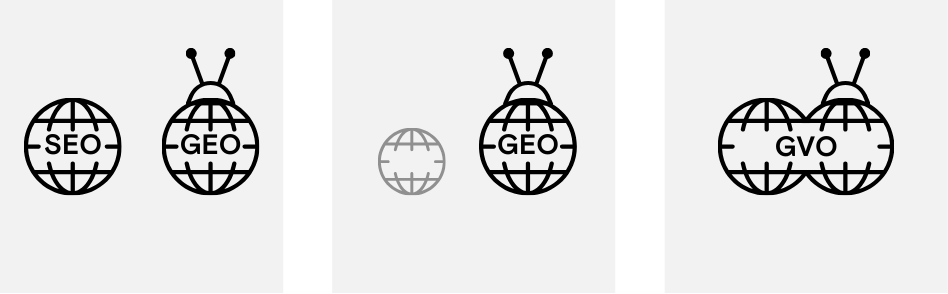
Scenario 1: Coexistence (realistic for 2025–2027)
SEO remains the foundation for traffic, GEO complements it with AI visibility.
→ SEO provides structure and the data layer, GEO adds trust and mentions.
→ Best practice: a “dual optimization framework” (see chapter 6.2 in the GEO paper).
Scenario 2: GEO displaces SEO (possible from 2028+)
With increasing integration of generative engines into browsers and operating systems, SERPs could fade into the background.
→ 90% of users interact only with AI assistants.
→ Visibility = mentions; clicks become irrelevant.
→ Early GEO adopters secure long-term market leadership.
Scenario 3: Convergence into “Generative Visibility Optimization (GVO)”
In the long run, GEO and SEO merge into a hybrid system that is optimized both for search engines and LLMs.
→ “GVO” combines semantic structure, AI readability and brand authority.
GEO and Venta AI – when visibility meets sales
Venta AI is built for this new world:
- The Adaptive Messaging Engine follows the same principles as GEO – context, relevance and timing.
- The AI sales worker not only generates leads, but uses data points to create personalized, context-aware communication.
GEO + Venta AI = the discovery loop:
- GEO makes your brand visible to AI.
- Venta AI turns that visibility into real deals.
In other words: content doesn’t just get found – it sells itself.
Conclusion: GEO is not a trend – it’s the next search logic
Search engines are evolving from “lists” to “answers”,
and brands need to start treating machine readability as a core part of their communication strategy.
Anyone who integrates GEO today:
- secures long-term visibility,
- strengthens their brand as an AI-trusted source, and
- connects marketing with measurable sales outcomes.
GEO is not the end of SEO.
It is SEO 2.0 – for the age of generative intelligence.